
Adapts HC3

Agentic modernization, at enterprise scale.

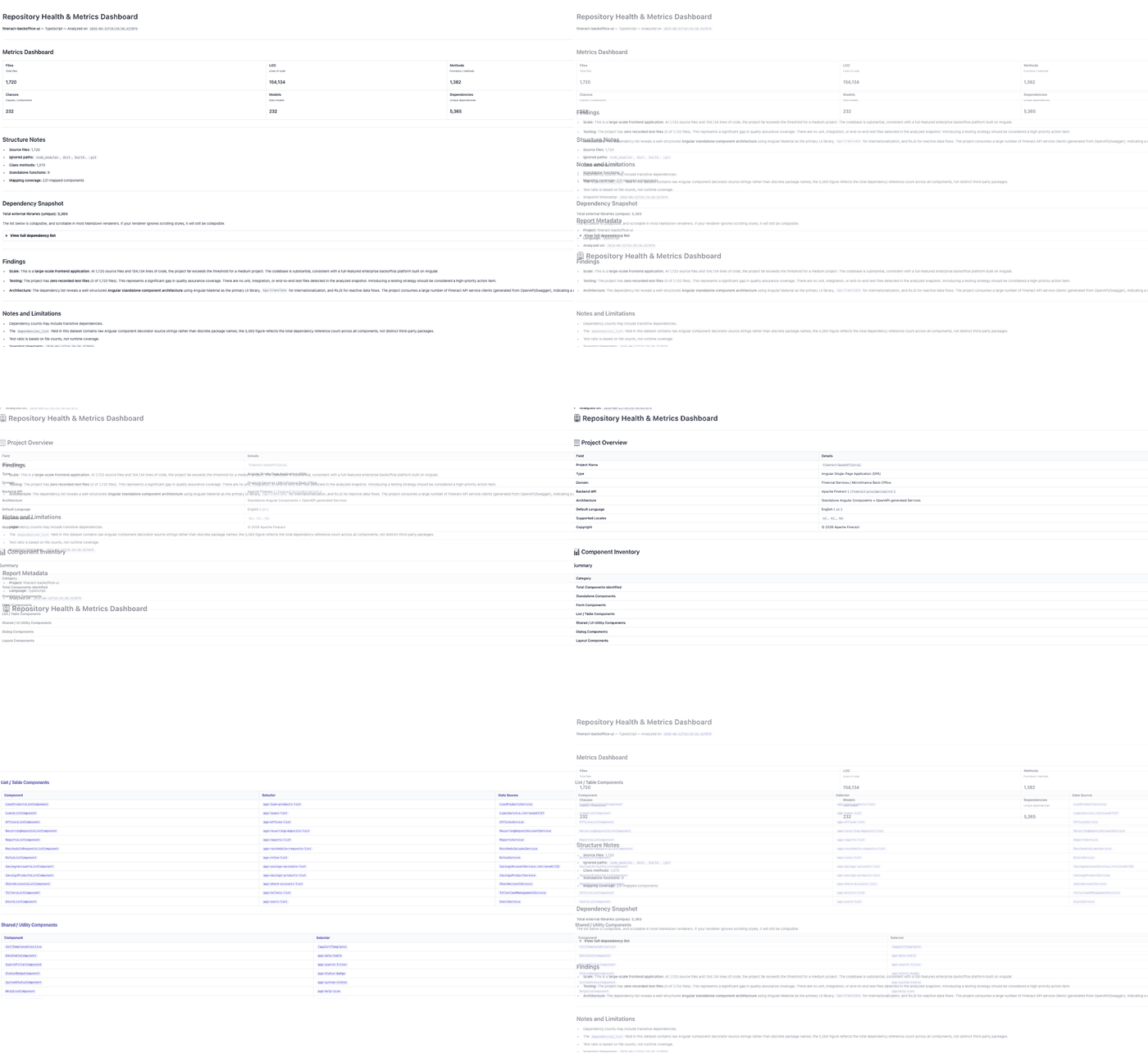
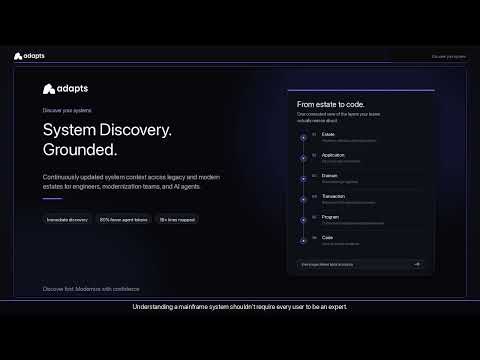
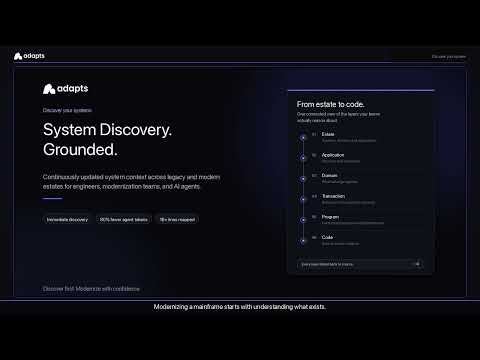
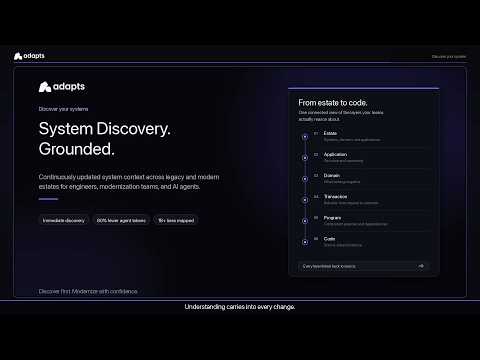
Adapts HC3 continuously indexes your codebases using deterministic analysis, building a living, queryable code ontology that evolves with every commit.

Proprietary Technology

Adapts HC3

Holistic Continuous Code Context

Inside HC3

Three engines, one grounded context

Adapts HC3 is built on three engines that keep code, structure, and surrounding context in sync · together they produce one queryable model of your system.

Adapts HC3Holistic Continuous Code Context
01
Code Cache
The code itself

Holds the actual source, per branch and latest commit, so answers are grounded in real code rather than guesses.

  • Parsed source & Static Analysis
  • Symbols, files & snippets
  • Latest per Branch
02
Code Portfolio Graph
Where the graph lives

Stores the deterministic graph of how everything connects, from a single repo up to your whole organization.

  • Deterministic connection graph
  • Repo → org scale
  • Always current with commits
03
External Data Graph
Additional source graph

Enriches the picture with context beyond the repo: docs, tickets, pipelines, and runtime signals.

  • Docs, tickets & specs
  • CI/CD & runtime signals
  • Third-party systems e.g. Jira, Confluence, Notion, ADO, etc.
Delivered via Chat · MCP Servers · IDE · Coding agents · Docs · APIs
Output
Grounded outcomes, not just answers
One queryable model turns into the deliverables your teams actually use · every one traceable to source
Understand
  • Onboarding
  • Architectural Diagrams
  • Drift Analysis
  • Gap Analysis
  • Code Review and Analysis
Plan
  • Implementation Plans
  • Modernization Plans
  • Scrum Boards
Build
  • Implementation Suites
  • Test Suites
  • Infrastructure as Code
  • DevOps
  • Release Notes

Our deterministic ontology engine continuously indexes enterprise codebases across legacy and modern languages. It builds a living store of business logic, dependencies, and undocumented workflows.

Not repo by repo. Across hundreds of interconnected repositories, services, and infrastructure layers.

Code Portfolio Graph

From one repo to the whole estate

Products ship through many service repos. Those repos share libraries. When a library changes, the graph shows every product and service in the blast radius · before the change lands.

  1. 01
    Repo GraphOne service codebase

    The atomic unit · symbols, files, and call paths inside a single repository.

  2. 02
    Library GraphShared packages repos depend on

    Internal libraries sit alongside repos. A repo depends on many libraries · reuse and blast radius live here.

  3. 03
    Product GraphMany service repos that ship together

    A product is a set of service repos · ownership, contracts, and release boundaries across them.

  4. 04
    Organization GraphMany products across the estate

    The full map · every product linked so modernization and change span the enterprise.

Grounded chat

From prompt to cited answer

Chat does not guess. It reads intent, selects the right graph sources, retrieves evidence, and only then asks the LLM to answer · with citations.

Adapts ChatGrounded · HC3
If we change charge() in payments-api, what else breaks?
Grounding from HC3…Intent · sources · evidence · LLM

6 callers across Payments Platform and Claims Portal.

Primary chain: charge() → authorizeCard() → postLedger() → emitSettled().

Shared lib risk: auth-sdk · also used by claims-api.

Sources: Code Chains · Data Sequence · Repo Graph.

  1. 01
    User promptReceive the question in chat
  2. 02
    Understand intentClassify as blast-radius · cross-service impact
  3. 03
    Pick the sourceCode Chains + Data Sequence · Payments Platform
  4. 04
    Retrieve datacharge() → auth-sdk · ledger-service · 6 callers
  5. 05
    Ground the LLMPrompt with graph evidence · not raw repo dump
  6. 06
    RespondCited answer back in chat
Adapts HC3 Advantage
Canonical context across every system

Adapts HC3 maps your entire system portfolio: every module, every business workflow, every dependency. When you change Service A, Adapts HC3 maps the blast radius across Services B, C, and D.

How It Works
Continuous, not point-in-time

Adapts HC3 indexes on every commit. As your codebase evolves, your deterministic map evolves with it. Current as of your last commit, not your last audit.

Enterprise Scale
Hundreds of repos, one context

Cross-repo dependency mapping, business logic extraction across languages, and full-stack awareness from infrastructure to UI. Built for the complexity enterprises actually have.

Deterministic + Continuous + Enterprise Scale
Grounded context, not hallucinations

Unlike one-time analyses or single-app tools, Adapts HC3 provides continuous, deterministic understanding across your entire system portfolio. AI tools get fact-grounded context from hundreds of interconnected services · not approximations from a single repo.

Deployment

Any stack. Any perimeter.

On-premise, air-gapped, or private cloud. Fully containerized · your code and metadata never cross your boundary. Adapts HC3 runs where your estate already lives.

60+
programming languages, legacy to modern
1B+
lines of code mapped in production estates
On-prem
air-gapped, or your private cloud
Containerized
Docker, Kubernetes, or OpenShift

How It Works

One engine. Four capabilities.

01

Understand

Map every system across your enterprise.

Living docs, architecture and dependency diagrams, spec coverage, and accurate Q&A · all grounded in the code. A deterministic map that stays current because Adapts HC3 indexes on every commit.

  • Auto-generated functional and technical specs
  • Interactive architecture and dependency diagrams
  • Natural language Q&A with full system context
Architect onboarding: 3 weeks → 2 days
02

Operate

Run delivery with full system context.

Cross-service review at PR time, downstream impact, security findings, and release summaries · so agent-driven PRs never outrun human code review.

  • Context-aware incident resolution
  • Change impact analysis before deployment
  • CI/CD integration with system-aware guardrails
Incident resolution: days → hours
03

Build

Give coding agents a map, not a guess.

Coding agents query a deterministic code graph instead of guessing, running continuously in your environment · not on the developer's machine.

  • Enterprise-scale context for AI coding agents
  • API-first integration with AI dev tools and CI/CD
  • MCP server integration for Claude, Codex, and any MCP-compatible agent
80% fewer agent tokens consumed
04

Adapt

Transform legacy systems safely, at scale.

Adapts HC3 understands the business rules embedded in legacy systems. It extracts them, designs the target architecture, and generates production-ready code and test suites.

  • Business logic and workflow extraction from legacy code
  • Target architecture generation with IaC
  • Production-ready code generation with test suites
Discovery phase: 18 months → 1 month

Continuous map

Drift detection, on every commit.

Legacy estates drift faster than documentation can follow. Adapts HC3 re-indexes on every commit so your deterministic map reflects what is actually in code · not what was true at the last audit.

Built for Your Role

One platform, tailored to every team.

CIOs, architects, engineering managers, and modernization PMs each need different depth. Adapts delivers deterministic context at the right level for each.

CIO / VP Engineering

Accelerate timelines, de-risk modernization, free budget for innovation.

Architecture discovery: weeks → hours
Enterprise Architect

Understand every system, map every dependency, design with confidence.

System behavior mapping: months → days
Engineering Manager

Delivery health and team productivity, one pane.

Onboarding: 3 weeks → 2 days
Modernization PM

Plans built from the real system · sequenced phases with evidence.

Discovery: 18 months → 1 month

See it on your codebase

See Adapts HC3 on a system like yours.

30-minute technical walkthrough with an enterprise architect. No slides · a live demo on real code.