

Mainframe
Mainframe is not a repository. It is an estate.
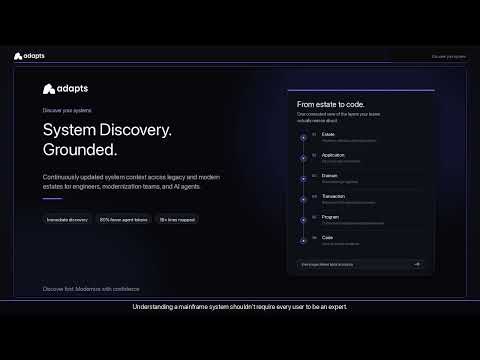
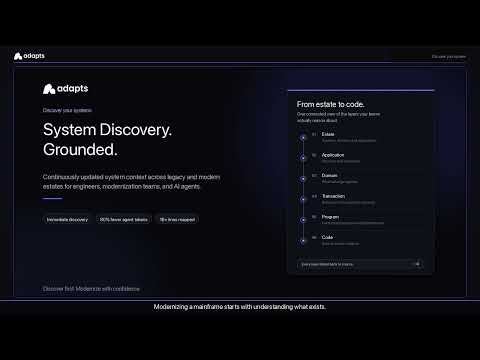
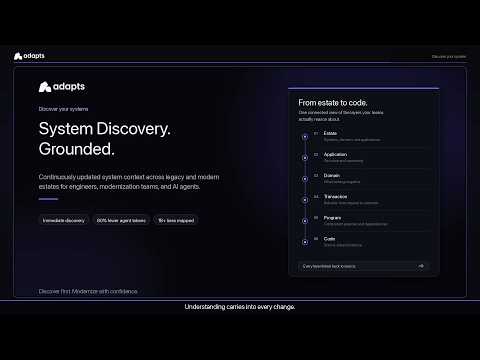
Adapts reconstructs programs, jobs, copybooks, databases, transactions, screens, and modern integrations into grounded system context—before engineers or agents modernize.
Dedicated mainframe expertise
Reconstruct how the estate actually works.
Adapts reconstructs how programs, jobs, copybooks, databases, transactions, screens, utilities and modern integrations actually work together.
Map the estate, not one repo at a time.
Relationships across programs, jobs, data, and shared artifacts—before you change anything.
- Cross-program dependenciesTrace shared logic across languages, jobs, and copybooks.
- Transaction and data flowConnect programs to middleware, data stores, batch, and screens.
- Cross-application impactSee what else breaks before modernization starts.
Mainframe ecosystem
The artifacts Adapts reads on the mainframe.
Languages, middleware, data stores, screens, batch, and the modern edges that touch them.
- COBOL
- JCL
- PL/I
- Copybooks
- CICS
- IDMS
- DB2
- ADSO
- Batch
- Screens
- Java / APIs
- Endevor
Same grounded model across the rest of the estate. See the full platform →
Why agents fail alone
Generic AI loses trust at mainframe scale.
LLMs can explain a file. They should not be asked to discover a 14,000-application estate from fragmented context. Deterministic mapping comes first.
Inside Adapts for mainframe estates
Three engines, one grounded mainframe context
The same three-engine architecture, re-grounded for the estate. Static parsers turn IDMS, COBOL, PL/I, DB2, HLASM, and JCL into one deterministic graph — from a single program to the whole enterprise.
Holds the parsed mainframe estate — not natural-language guesses — so answers are grounded in real IDMS, COBOL, PL/I, DB2, HLASM, and JCL.
- Static parsers: IDMS, COBOL, PL/I, DB2, HLASM, JCL
- Copybooks, PDS members & CICS/BMS/ADSO artifacts
- Latest per load module & compile
Stores the deterministic graph of how everything connects — from a single program or copybook up to jobs, transactions, and the whole enterprise.
- Deterministic connection graph
- Program/copybook → application → enterprise scale
- Job, started task & CICS transaction linkage
Enriches the picture with context beyond the source: runbooks, tickets, job schedulers, and mainframe runtime signals.
- Runbooks, tickets & specs
- Job schedulers & SMF/CICS runtime signals
- Third-party systems e.g. Jira, Confluence, Notion, ADO, etc.
- Onboarding
- Architectural Diagrams
- Drift Analysis
- Gap Analysis
- Code Review and Analysis
- Implementation Plans
- Modernization Plans
- Scrum Boards
- Implementation Suites
- Test Suites
- Infrastructure as Code
- DevOps
- Release Notes
Start with one mainframe application
Discover your system.
See what Adapts reconstructs across COBOL, JCL, CICS, IDMS, DB2, and the jobs and screens that bind them—dependencies, transactions, and source-linked evidence.